Battle of the Eclipse - Eclipse of Thales
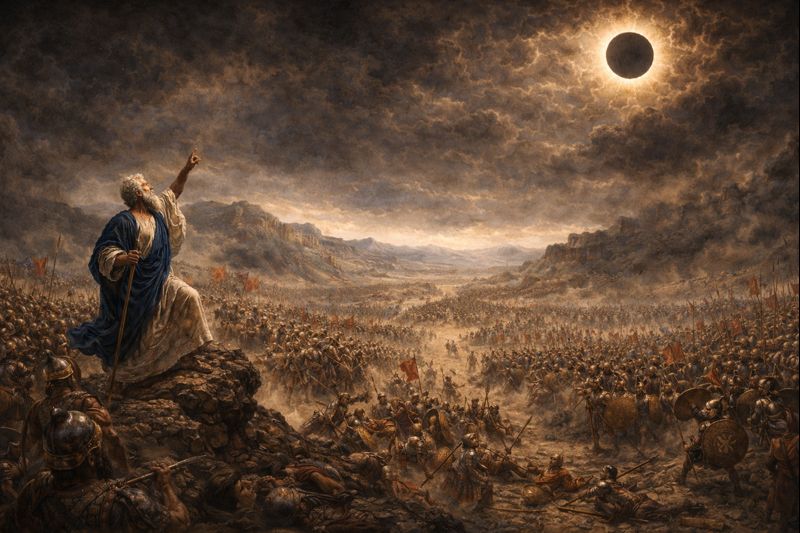
According to the Greek historian Herodotus, writing roughly 150 years later, a total solar eclipse was foretold by the philosopher Thales of Miletus. In Herodotus’ account this eclipse stands as the earliest known instance in which a celestial event was predicted in advance, marking a profound shift in how humans understood the cosmos.
The eclipse is commonly identified by modern scholars as the solar eclipse of 28 May 585 BCE. It occurred during a violent clash between the kingdoms of Lydia and Media, a conflict later known as the Battle of the Eclipse. As the fighting intensified, daylight abruptly faded into darkness. To the soldiers on the battlefield, the sudden nightfall was terrifying—an unmistakable omen. Weapons were lowered, the battle halted, and both sides turned from violence to negotiation.
Herodotus tells us that Thales had warned the Ionians that such a change would occur within that very year, though he offers no details about the method of prediction. This absence has fueled centuries of debate. Modern historians remain skeptical, questioning whether Thales truly foresaw the eclipse or whether the story was later embellished. Some argue alternative dates or interpretations, while others see symbolic storytelling rather than precise science.
Yet regardless of uncertainty, the impact was real. Peace was forged, sealed by marriage between royal houses, and the Halys River was set as the boundary between the two realms. Centuries later, Isaac Asimov would call this moment “the birth of science”—a point where humanity first dared to believe that even the heavens followed knowable laws.
What / Source: According to ancient accounts (notably cited by later classical authors), during a battle between the Medes and the Lydians near the River Halys, the Sun was suddenly eclipsed, which both sides interpreted as an omen and triggered a truce. This event is held to coincide with a real total solar eclipse.